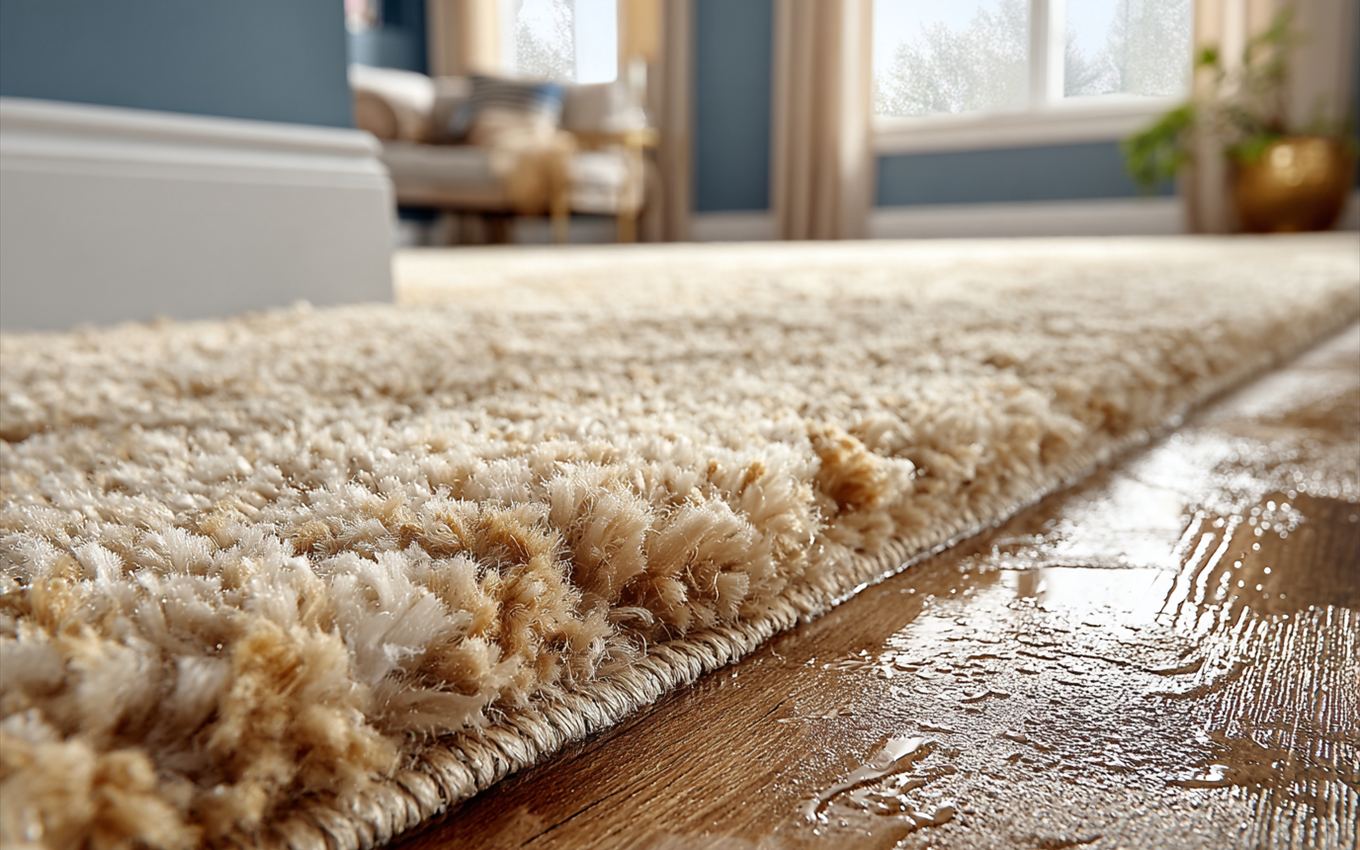
When carpet gets soaked, people usually ask one question first: can it be saved? Often the honest answer is partly. A carpeted floor is four layers, and they don't all react to water the same way. Knowing which layer is which, and what each one does when it's wet, makes the restoration company's decisions easier to follow.
The Four Layers
- The carpet itself: face fibers woven or tufted into a backing, usually two layers of backing glued together.
- The pad, a foam or fiber cushion under the carpet.
- The tack strip, thin wood strips with angled nails around the edge of the room that hold the carpet tight.
- The subfloor, plywood or OSB over the floor joists, or a concrete slab.
What Water Does to Each
| Layer | When it gets wet | Usual outcome |
|---|---|---|
| Carpet | Holds some water; the backing glue can weaken if soaked for long | Often dried and relaid if the water was clean and it's dealt with quickly |
| Pad | Soaks up water like a sponge and holds it | Almost always replaced; it's inexpensive and hard to dry |
| Tack strip | Wood swells, nails can rust | Often replaced with the pad |
| Plywood subfloor | Absorbs water, usually dries | Dried in place |
| OSB subfloor | Swells, especially at the edges | Dried; replaced if it stays swollen |
| Concrete slab | Absorbs some water slowly | Dried and checked with a meter before new pad goes down |
The Three Things That Decide It
Where the water came from. Clean water from a supply line, a water heater or a sink is the best case. Water that ran through a dirty space, or came in from outside, usually means the carpet goes too.
How long it sat. Carpet and pad that are extracted within a day have a good chance. After two or three days of sitting wet, the pad starts to smell and the backing can start to separate. The odds of saving the carpet drop quickly.
What kind of carpet. Some carpets hold up to a soak better than others. Older carpet, carpet with a weak backing, or carpet glued directly to the floor is harder to save.
How a Carpet Gets Dried
The company extracts as much water as it can through the carpet, then lifts the carpet back from the tack strip and pulls the wet pad. With the pad gone, it checks the subfloor with a meter. Air movers go under the lifted carpet and across the subfloor, and dehumidifiers run with the room closed. Once the subfloor reads dry, new pad and tack strip go down, and the carpet is stretched back into place.
Your Part, Before the Company Arrives
- Stop the water at the source or the main.
- Get furniture off the wet carpet, or put foil or plastic under the legs.
- Pick up rugs and anything that can bleed dye.
- Don't run a household vacuum on wet carpet.
- Open interior doors between the wet room and the rest of the house, but keep exterior doors and windows closed in damp weather.
- Photograph everything before it's moved.
Carpet on Concrete
Carpet over a concrete slab, common in garages converted to living space and some ground-floor rooms, behaves a little differently. The slab doesn't swell or rot, but it absorbs water slowly and releases it slowly. Pad on concrete stays wet longer, and concrete has to read dry before new pad goes down, or the new pad gets wet from below. Expect drying to take a bit longer on a slab, and expect the company to check the concrete with a meter.
Stairs and Hallways
Carpeted stairs and hallways often catch water running from one room to another. Each stair tread has its own small piece of pad, and the stringers underneath can hold water. Expect stairs to take extra time.
Wall-to-Wall Versus Area Rugs
An area rug can be rolled up and taken out of the room. Wall-to-wall carpet can't, so it has to be dried in place or replaced. That's another reason area rugs on hard floors are often easier to save.
Questions
Will my carpet shrink after it dries?
It can shrink a little or come loose at the seams. When it's relaid, it's re-stretched, which usually takes care of it.
Why are they throwing out the pad if the carpet's being kept?
Because the pad holds most of the water and is hard to dry all the way through. New pad is inexpensive, and keeping wet pad risks smells and a damp subfloor.
Can area rugs be saved?
Often, if they're picked up quickly and cleaned and dried off-site. Valuable or hand-knotted rugs should go to a rug specialist.
Around Puyallup
Carpet calls come from all over, especially Fruitland, Midland and Parkland. The full process is on water removal and carpet extraction.
EPA on indoor air and dampness
The First Hour: What to Do Before Help Arrives
A short list for the first hour after you find water.
Drying Equipment at Home: Noise, Power and Patience
Noise, power, closed doors and pets while the house dries.